When you hire a commercial window cleaning company, most people focus on price and availability — but rarely ask the question that matters most: How are you actually going to clean my building?
The method used makes a real difference. It affects safety, cost, how long the job takes, and how much it disrupts your tenants and daily operations. If you manage or own a commercial property in San Francisco or the Bay Area, here’s what you need to know about the three most common high-rise window cleaning methods.
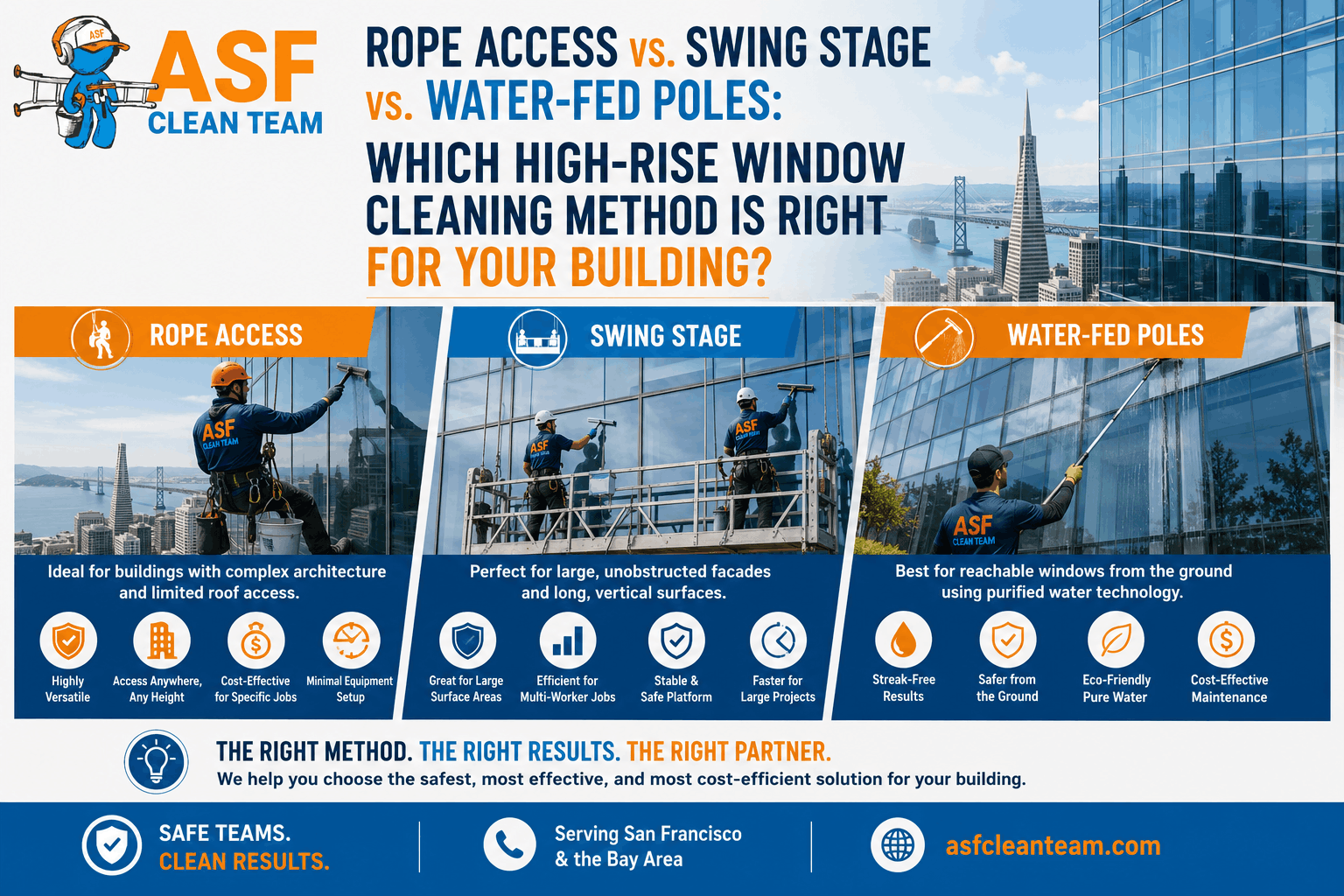
- Rope Access — The Modern Standard for True High-Rises
Rope access involves trained technicians descending the face of a building using a dual-rope system — a working line and an independent safety backup — secured to certified anchor points on the rooftop. It’s governed by strict industry standards and requires purpose-trained, certified technicians.
Best for: Tall or architecturally complex buildings where platforms can’t easily reach every surface.
Why it works well: Rope access has a minimal ground footprint — no cranes, no sidewalk closures, no heavy equipment permits. Technicians can navigate setbacks, curved facades, and recessed windows that swing stages simply can’t reach. Mobilization is fast, disruption to tenants is low, and for complex high-rises, it’s often the most cost-effective option available.
The catch: Work stops in high winds or heavy rain. And because it requires certified technicians and proper rooftop anchor points, not every cleaning company can offer it. Always ask for proof of certification and itemized insurance before any rope access work begins on your property.
- Swing Stage — The Traditional Approach
The swing stage (or suspended scaffold) is the method most people picture when they think of high-rise window washers — a motorized platform lowered down the building face by cables, with workers standing on it. Many newer commercial towers also have a permanent Building Maintenance Unit (BMU) built in as part of the building’s design.
Best for: Large, flat-faced towers — especially those already equipped with a permanent BMU system.
Why it works well: On a wide, uniform facade with an existing BMU, swing stages are efficient and familiar. Workers cover large horizontal sections per pass, and the stable platform can accommodate heavier cleaning equipment when needed.
The catch: For buildings without a permanent system, temporary swing stages require significant setup — rigging inspections, permits, and equipment that takes up sidewalk space for days. They’re also highly weather-sensitive and difficult to use on buildings with irregular facades or architectural details. In a dense urban environment like San Francisco, this disruption adds up quickly, which is why many modern contractors are moving away from this method.
- Water-Fed Poles — Ideal for Low- to Mid-Rise Commercial Properties
Water-fed pole systems use telescoping carbon fiber poles — sometimes reaching 50 to 70 feet — fitted with a brush head and fed with purified water from a ground-level tank. Because the water is 100% mineral-free, it dries completely clear without streaking or spotting, and no chemicals are required.
Best for: Storefronts, office parks, and commercial buildings up to about 5–7 stories.
Why it works well: Technicians stay on the ground the entire time, which makes this the safest of the three methods by a wide margin. There’s no rigging, no permits, no platform below blocking foot traffic, and mobilization is extremely fast. For regular maintenance cleaning on low- to mid-rise properties, it delivers outstanding results at a very competitive cost.
The catch: Standard systems don’t reach above 7 stories, so it’s not a standalone solution for true high-rises.
Which Method Is Right for Your Building?
The honest answer: it depends on your building. A 20-story tower in the Financial District has different needs than a 4-story office park in Oakland. The best contractors assess your building individually and choose the right method — or combination of methods — rather than defaulting to whatever is easiest for them.
At ASF Clean Team, we prioritize rope access and water-fed pole systems for most of our commercial work across San Francisco and the Bay Area. It’s a modern, flexible approach that minimizes disruption, keeps our team safe, and delivers consistently excellent results.
Want to find out which method is right for your property? Contact ASF Clean Team today for a free, no-obligation site assessment and quote.
📞 San Francisco: (415) 299-2844 | East Bay: (510) 214-7548