How to Prepare Your Gutters for El Niño and Heavy Rain?

Every few years, forecasters start using a word that makes Bay Area homeowners pay attention: El Niño. These climate patterns can bring significantly wetter-than-normal winters to Northern California, with intense atmospheric rivers dumping heavy rain in short bursts. If your gutters aren’t ready, the difference between a dry winter and a costly one often comes down to a few hours of preparation. Here’s how to get your home ready.

Why El Niño Years Are Different

A typical rainstorm gives your gutters a steady, manageable flow of water. El Niño-driven storms are a different story — they tend to bring intense, concentrated downpours over short periods. That means your gutter system has to move a much larger volume of water in a much shorter window. Any existing clog, sag, or weak spot that might have gone unnoticed in a mild year becomes a serious liability in a heavy one.

  1. Start with a Full Inspection, Not Just a Cleaning

Before the rains hit, it’s worth having your entire gutter system inspected — not just cleared of leaves. This means checking for loose brackets, pulled-away sections, rust or corrosion, and downspouts that may be crushed or disconnected underground. A clean gutter with a structural problem will still fail under heavy flow.

  1. Clear Debris from Gutters and Downspouts

Obvious, but essential. Leaves, pine needles, and seed pods accumulate quickly in Oakland and the surrounding hills, and even a partial blockage can cause water to back up and overflow during a heavy storm. Downspouts should be checked too — a clog several feet down the pipe is just as damaging as one in the gutter itself.

  1. Check Your Downspout Extensions and Drainage

During heavy rain years, water needs to travel well away from your foundation, not just off the roof. Make sure downspout extensions are directing water at least several feet from your home, and check that ground-level drainage isn’t blocked by mulch, dirt, or debris buildup.

  1. Look for Signs of Previous Water Damage

Stains on the fascia board, peeling paint near the roofline, or soft spots in the wood can indicate a problem from a previous storm season that never fully dried out. Heavy rain will find and exploit these weak points fast, so it’s worth addressing them before the next round of storms.

  1. Consider Gutter Guards for Long-Term Protection

If your property has significant tree cover, gutter guards can reduce how often debris builds up between cleanings — helpful during a season when storms come back-to-back and there’s less of a dry window to catch up on maintenance.

  1. Don’t Wait Until the First Storm Warning

Once a storm system is forecast, plumbers, roofers, and gutter cleaners across the Bay Area get booked up fast. Scheduling your gutter prep a few weeks ahead of the wet season gives you priority access and time to fix anything that turns up during inspection.

How Does ASF Clean Team Help with Gutter Cleaning in Rainy Season?

ASF Clean Team specializes in getting Oakland homes ready for exactly this kind of high-volume rain. We provide thorough gutter and downspout cleaning, inspect for structural issues like sagging or loose fasteners, and check that your drainage system can handle sustained heavy flow — not just a light drizzle. Heading into an El Niño year, we can also set up recurring seasonal maintenance so your gutters stay clear through consecutive storms rather than just the first one.

Don’t wait for the first atmospheric river to find out your gutters weren’t ready. Contact ASF Clean Team today to get your home prepared before the rainy season peaks.


gutter cleaning services Oakland

Signs Your Gutters Need Cleaning in Oakland, Before the Next Storm Hits

Oakland’s rainy season doesn’t wait for a convenient time. Between towering oaks, eucalyptus, and pine trees that line many East Bay neighborhoods, gutters here fill up fast — and clogged gutters during a storm can mean water pouring down your siding, pooling near your foundation, or even seeping into your attic. Catching the warning signs early can save you thousands in repairs. Here’s what to watch for.

gutter cleaning services Oakland
  1. Water Spilling Over the Edges

If you’ve noticed water cascading over the sides of your gutters during a light rain instead of flowing through the downspouts, that’s the clearest sign of a blockage. In Oakland’s hillier neighborhoods like Montclair or the Oakland Hills, overflowing water can quickly erode landscaping or undermine a foundation on a slope.

  1. Sagging or Pulling Away Gutters

Gutters are designed to hold water, not sit full of it 24/7. When leaves, twigs, and dirt build up, the added weight can cause gutters to sag, pull away from the fascia board, or even detach entirely. If your gutters look wavy or uneven along the roofline, it’s a sign they’re carrying more than they should.

  1. Visible Plants or Weeds Growing in the Gutter

Yes, this happens more often than people think. When decomposing leaves and debris sit in a gutter long enough, they create a mini planter box. Sprouting weeds or small plants along your roofline are a clear signal your gutters haven’t been cleaned in a while.

  1. Stains or Streaks on Your Siding

Dark streaks running down your exterior walls, especially below the gutter line, usually mean water is overflowing rather than draining properly. Left unaddressed, this can lead to peeling paint, wood rot, or mold growth — all of which are far more expensive to fix than a gutter cleaning.

  1. Pests Around the Roofline

Standing water and decaying leaves in clogged gutters are an open invitation for mosquitoes, rodents, and birds. If you’re noticing more pest activity near your roof than usual, your gutters could be the culprit.

  1. Basement or Crawl Space Dampness

When gutters can’t channel water away from your home, it pools near the foundation and can seep into basements or crawl spaces. If you’ve noticed new dampness, musty odors, or water stains indoors after a rainstorm, your gutter system may be overwhelmed.

  1. It’s Been More Than 6 Months Since Your Last Cleaning

Even without obvious symptoms, gutters should generally be cleaned at least twice a year in Oakland — once in late fall before the rainy season begins, and again in spring to clear out debris from winter storms. Homes surrounded by mature trees may need more frequent attention.

Why Timing Matters in Oakland

Oakland’s microclimates mean some neighborhoods get significantly more rainfall and wind than others, and storm intensity can escalate quickly. Waiting until you see a problem often means you’re already dealing with water damage. A proactive cleaning before the next storm is far cheaper than repairing a compromised roofline, siding, or foundation afterward.

How Does ASF Clean Team Help with Gutter Cleaning in Oakland?

This is exactly where ASF Clean Team comes in. Our team knows Oakland’s unique mix of tree cover, hillside homes, and unpredictable weather patterns, and we tailor our gutter cleaning services accordingly. We thoroughly clear leaves, debris, and buildup from your gutters and downspouts, check for early signs of sagging or damage, and make sure water has a clear path away from your home before the next storm arrives.

Beyond a one-time cleaning, we can also set up a seasonal maintenance schedule so you never have to worry about surprise overflow or costly water damage again. If you’re seeing any of the warning signs above, don’t wait for the next downpour — reach out to ASF Clean Team and let us handle the gutters so you can focus on everything else.

Gutter Cleaning in Oakland

How to Choose the Best Gutter Cleaning Company in Oakland?

Your gutters do a lot of quiet, unglamorous work. When they’re clogged with leaves, dirt, and debris, that quiet work stops — and water starts finding its way into places it shouldn’t: your fascia, your foundation, your landscaping. If you’re searching for Gutter Cleaning in Oakland, choosing the right company matters more than most homeowners realize. Here’s what to actually look for, and why ASF Clean Team checks every box.

Gutter Cleaning in Oakland
  1. Local Experience Matters

Oakland’s mix of older homes, hillside properties, and mature tree canopy means gutters here face a unique set of challenges — from oak leaves and pine needles to the debris that comes with our rainy winters. A company that specializes in Gutter Cleaning in Oakland specifically will know which neighborhoods see the heaviest buildup, how steep local rooflines tend to be, and what seasonal timing actually works for this climate. National franchises and one-size-fits-all crews often miss these local details.

  1. Proper Equipment and Safety Practices

Gutter cleaning isn’t just about scooping out leaves — it’s about doing it safely and thoroughly, without damaging your roofline or gutters in the process. The best companies show up with the right ladders, harnesses, and tools for multi-story homes, and they know how to work around delicate landscaping, solar panels, and gutter guards without causing damage. If a company can’t clearly explain their safety process, that’s a red flag.

  1. Full-Service Cleaning, Not Just a Quick Scoop

A thorough job means clearing gutters and downspouts completely, flushing them with water to confirm proper flow, and checking for early signs of sagging, rust, or loose brackets. Some companies rush through the visible parts and skip the downspouts entirely — which means water can still back up even after a “cleaning.” Ask potential companies exactly what’s included before you book.

  1. Transparent Pricing and Honest Recommendations

Reliable gutter cleaning companies give clear, upfront pricing with no surprise add-ons. Just as important, they should tell you the truth about your gutters — whether they’re in good shape, need minor repairs, or are due for replacement — rather than upselling services you don’t need.

  1. Reviews, Licensing, and Insurance

Before hiring anyone to work on your roofline, confirm they’re licensed and insured. This protects you if anything goes wrong during the job. Then check reviews specifically from Oakland customers — general national ratings don’t tell you much about how a company performs on local homes with local conditions.

Why ASF Clean Team Is the Right Choice?

When you weigh all of these factors, ASF Clean Team stands out as the top choice for Gutter Cleaning in Oakland. Here’s why homeowners across the city trust us:

Local expertise: We know Oakland’s homes, trees, and weather patterns inside and out, and we tailor our cleaning schedule to match what your property actually needs.

Thorough, safety-first service: Our team fully clears gutters and downspouts, checks for flow, and inspects for early warning signs — all using proper safety equipment, every time.

Honest, upfront communication: We tell you exactly what your gutters need, with transparent pricing and no pressure to buy services you don’t need.

Reliable and insured: We’re fully licensed and insured, so you can have complete peace of mind while we work on your home.

A reputation built on results: Our Oakland customers keep coming back because we do the job right the first time.

Clogged gutters are a small problem that turns into an expensive one if you wait too long. When you’re ready for dependable, detail-oriented Gutter Cleaning in Oakland, ASF Clean Team is here to help protect your home — one clean gutter at a time.

Ready to book? Contact ASF Clean Team today and see why we’re Oakland’s trusted choice for gutter cleaning.

pressure washing service san francisco

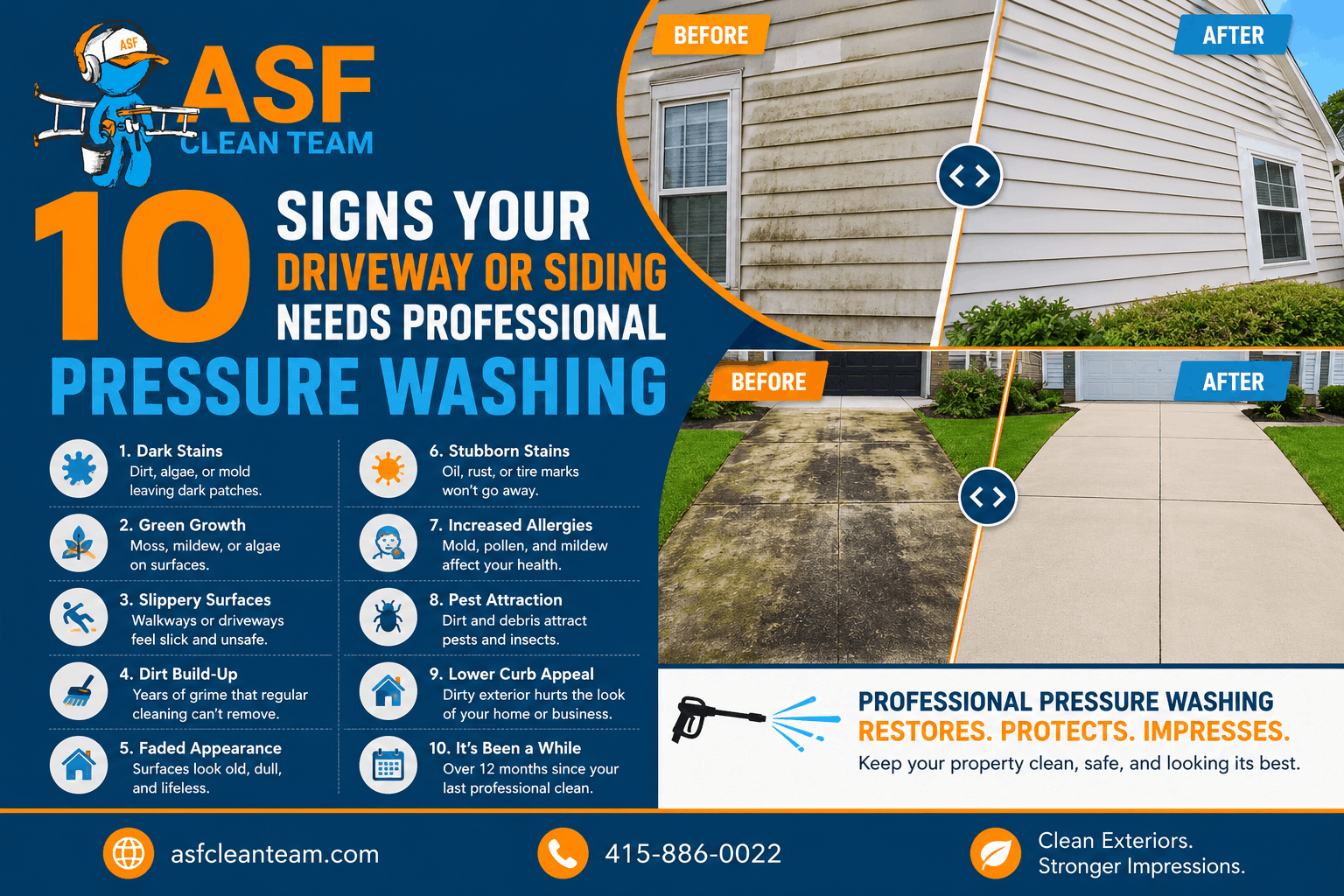
10 Signs Your Driveway or Siding Needs Professional Pressure Washing

San Francisco’s fog, salt air, and damp winters do a number on the outside of your home. Dirt, mold, and grime build up slowly, so it’s easy to miss the warning signs until your driveway or siding looks years older than it actually is. Here are 10 signs it’s time to call in a professional pressure washing crew.

pressure washing service san francisco
  1. Dark Streaks or Stains on Siding

Black or greenish streaks running down your siding are usually algae or mold, thriving in SF’s moisture-heavy climate. They spread quickly and can eat into paint and wood if left untreated.

  1. Green or Black Patches on the Driveway

Concrete driveways that stay shaded or damp often develop moss and algae patches. Beyond looking bad, these patches get slippery when wet, which is a real safety hazard on sloped SF streets.

  1. Visible Mold or Mildew Around Windows and Corners

Mold tends to collect in corners, under eaves, and around window frames, where airflow is limited. If you’re noticing fuzzy black or gray spots in these areas, it’s spread further than you can see.

  1. A Chalky or Faded Exterior

If your siding looks dull, chalky, or washed-out compared to when it was painted, it’s likely coated in a fine layer of dirt and oxidation. Pressure washing can restore the original color and make future repainting last longer.

  1. Stubborn Oil or Rust Stains on Concrete

Oil drips from parked cars and rust from metal furniture or fixtures leave stains that don’t come off with a hose. Professional-grade equipment and cleaning solutions lift these stains without damaging the concrete.

  1. Cobwebs, Dust, and Debris Buildup

If your entryway, porch, or garage door has accumulated cobwebs and dust that keep coming back no matter how often you sweep, a deep clean resets the surface and keeps pests away longer.

  1. Cracks Filled with Dirt or Moss

Small cracks in your driveway or walkway that are packed with dirt, moss, or weeds aren’t just an eyesore — trapped moisture in these cracks can widen them over time, leading to costlier repairs.

  1. A Musty Smell Near Your Foundation

A persistent musty or earthy smell near your home’s exterior often points to trapped mold or mildew. Pressure washing combined with proper drainage can eliminate the source rather than just masking it.

  1. Graffiti or Unexplained Marks

San Francisco properties, especially storefronts and fences, are common graffiti targets. Quick, professional removal prevents staining from setting into porous surfaces like stucco or brick.

  1. It’s Been More Than a Year Since Your Last Cleaning

Even without obvious stains, most SF homes benefit from a professional pressure wash at least once a year. Regular cleaning prevents buildup from ever reaching the point where it damages paint, wood, or concrete.

How ASF Clean Team Can Help

If any of these signs sound familiar, ASF Clean Team is here to help. We provide professional pressure washing and soft washing services throughout San Francisco, tailored to the unique challenges of the city’s climate — from salt air corrosion to persistent fog-driven mold and algae growth.

Our team uses commercial-grade equipment and eco-friendly cleaning solutions that are safe for your driveway, siding, plants, and pets, while still delivering a deep, lasting clean. Whether you need a one-time deep clean for your Victorian-style home, routine maintenance for an HOA property, or storefront cleaning for your San Francisco business, we tailor our approach to the surface and the problem — no guesswork, no damage.

Don’t wait for stains to set in or cracks to widen. Contact ASF Clean Team today for a free quote and let us restore your driveway and siding to a like-new finish.

High-Rise Window Cleaning San Francisco

Rope Access vs. Swing Stage vs. Water-Fed Poles: Which High-Rise Window Cleaning Method Is Right for Your Building?

When you hire a commercial window cleaning company, most people focus on price and availability — but rarely ask the question that matters most: How are you actually going to clean my building?

The method used makes a real difference. It affects safety, cost, how long the job takes, and how much it disrupts your tenants and daily operations. If you manage or own a commercial property in San Francisco or the Bay Area, here’s what you need to know about the three most common high-rise window cleaning methods.

High-Rise Window Cleaning San Francisco
  1. Rope Access — The Modern Standard for True High-Rises

Rope access involves trained technicians descending the face of a building using a dual-rope system — a working line and an independent safety backup — secured to certified anchor points on the rooftop. It’s governed by strict industry standards and requires purpose-trained, certified technicians.

Best for: Tall or architecturally complex buildings where platforms can’t easily reach every surface.

Why it works well: Rope access has a minimal ground footprint — no cranes, no sidewalk closures, no heavy equipment permits. Technicians can navigate setbacks, curved facades, and recessed windows that swing stages simply can’t reach. Mobilization is fast, disruption to tenants is low, and for complex high-rises, it’s often the most cost-effective option available.

The catch: Work stops in high winds or heavy rain. And because it requires certified technicians and proper rooftop anchor points, not every cleaning company can offer it. Always ask for proof of certification and itemized insurance before any rope access work begins on your property.

  1. Swing Stage — The Traditional Approach

The swing stage (or suspended scaffold) is the method most people picture when they think of high-rise window washers — a motorized platform lowered down the building face by cables, with workers standing on it. Many newer commercial towers also have a permanent Building Maintenance Unit (BMU) built in as part of the building’s design.

Best for: Large, flat-faced towers — especially those already equipped with a permanent BMU system.

Why it works well: On a wide, uniform facade with an existing BMU, swing stages are efficient and familiar. Workers cover large horizontal sections per pass, and the stable platform can accommodate heavier cleaning equipment when needed.

The catch: For buildings without a permanent system, temporary swing stages require significant setup — rigging inspections, permits, and equipment that takes up sidewalk space for days. They’re also highly weather-sensitive and difficult to use on buildings with irregular facades or architectural details. In a dense urban environment like San Francisco, this disruption adds up quickly, which is why many modern contractors are moving away from this method.

  1. Water-Fed Poles — Ideal for Low- to Mid-Rise Commercial Properties

Water-fed pole systems use telescoping carbon fiber poles — sometimes reaching 50 to 70 feet — fitted with a brush head and fed with purified water from a ground-level tank. Because the water is 100% mineral-free, it dries completely clear without streaking or spotting, and no chemicals are required.

Best for: Storefronts, office parks, and commercial buildings up to about 5–7 stories.

Why it works well: Technicians stay on the ground the entire time, which makes this the safest of the three methods by a wide margin. There’s no rigging, no permits, no platform below blocking foot traffic, and mobilization is extremely fast. For regular maintenance cleaning on low- to mid-rise properties, it delivers outstanding results at a very competitive cost.

The catch: Standard systems don’t reach above 7 stories, so it’s not a standalone solution for true high-rises.

Which Method Is Right for Your Building?

The honest answer: it depends on your building. A 20-story tower in the Financial District has different needs than a 4-story office park in Oakland. The best contractors assess your building individually and choose the right method — or combination of methods — rather than defaulting to whatever is easiest for them.

At ASF Clean Team, we prioritize rope access and water-fed pole systems for most of our commercial work across San Francisco and the Bay Area. It’s a modern, flexible approach that minimizes disruption, keeps our team safe, and delivers consistently excellent results.

Want to find out which method is right for your property? Contact ASF Clean Team today for a free, no-obligation site assessment and quote.

📞 San Francisco: (415) 299-2844 | East Bay: (510) 214-7548

Soft & Pressure Washing San Francisco

Soft Washing vs. Pressure Washing: Which Is Right for Your San Francisco Home?

If your home’s exterior is looking dingy, streaked, or covered in grime, you’ve probably searched for pressure washing San Francisco companies to help restore your curb appeal. But before you book a service, it’s worth understanding that “pressure washing” isn’t a one-size-fits-all solution — and using the wrong method on the wrong surface can actually cause damage.

Soft & Pressure Washing San Francisco

At ASF Clean Team, we offer both soft washing and pressure washing because San Francisco homes come in so many different styles, materials, and ages. Here’s how to tell which one your property actually needs.

What Is Pressure Washing?

Pressure washing uses a high-powered stream of water — often at pressures between 1,500 and 4,000 PSI — to blast away dirt, grease, algae, gum, and grime from hard, durable surfaces. It’s the go-to method for:

• Concrete driveways and walkways
• Brick and stone patios
• Garage floors
• Sidewalks and parking areas
• Fences and decks (with caution)

Because of the sheer force involved, pressure washing is excellent at removing stubborn buildup like oil stains, tire marks, and years of embedded dirt. However, that same force can strip paint, damage wood siding, crack stucco, or dislodge roof shingles if used on delicate surfaces.

What Is Soft Washing?

Soft washing uses low-pressure water combined with specialized, eco-friendly cleaning solutions to gently lift and eliminate dirt, mold, mildew, and algae. Instead of relying on brute force, soft washing relies on chemistry to do the heavy lifting. This makes it the safer choice for:

• Painted or stucco siding (a San Francisco classic)
• Wood shingles and shake siding
• Roofs
• Delicate trim, windows, and architectural details
• Older Victorian and Edwardian homes

Given how many San Francisco homes feature historic wood siding, stucco facades, and painted trim, soft washing is often the better fit for the exterior walls of the house itself — preserving both the material and the paint job while still delivering a deep clean.

Why the Right Method Matters in San Francisco

San Francisco’s unique climate plays a big role in this decision. The city’s persistent fog, coastal moisture, and salty ocean air create the perfect environment for mold, mildew, algae, and moss to take hold on exterior surfaces. At the same time, the city is filled with older homes — Victorians, Edwardians, and craftsman-style builds — that feature wood siding, decorative trim, and painted surfaces that can be easily damaged by high-pressure water.

That’s why a blanket approach doesn’t work here. A skilled exterior cleaning team will typically:

Pressure wash the driveway, walkways, patio, and any concrete or masonry surfaces
Soft wash the siding, stucco, roof, and delicate trim
• Adjust pressure and technique based on the specific material of each surface

The Risks of DIY or Choosing the Wrong Method

Renting a pressure washer and tackling the job yourself might seem like a money-saver, but it’s one of the most common ways homeowners accidentally damage their property. Too much pressure on stucco can crack it. Aiming a high-pressure stream at wood siding can force water behind the boards, leading to rot and mold growth inside the walls. And pressure washing a roof can void your shingle warranty and shorten its lifespan.

Professional exterior cleaners know which technique, pressure level, and cleaning solution to use on each surface — protecting your investment while still achieving a spotless result.

Which One Does Your Home Need?

For most San Francisco properties, the answer is: both. Hard, non-porous surfaces like concrete and stone benefit from pressure washing, while painted, wooden, or delicate surfaces call for soft washing. A professional assessment of your property is the best way to determine the right combination for a thorough, damage-free clean.

Get a Free Quote from ASF Clean Team

ASF Clean Team has years of experience providing both soft washing and pressure washing in San Francisco and the greater Bay Area. Our licensed and insured technicians know exactly which method fits every surface on your property, so you get a spotless exterior without the risk of damage.

Contact ASF Clean Team today for a free, no-obligation quote and let us help you find the right cleaning solution for your San Francisco home.

window cleaning San Francisco

The Unique Window Cleaning Challenges of San Francisco’s Climate (And How to Handle Them)

If you own property in San Francisco, you’ve probably noticed something frustrating: your windows seem to get dirty faster here than almost anywhere else. That’s not your imagination. San Francisco’s microclimate creates a perfect storm of grime-building conditions that most window cleaning companies elsewhere never have to think about. Understanding these local factors — and knowing how to properly counteract them — is exactly why window cleaning San Francisco requires a different approach than a one-size-fits-all service.

window cleaning San Francisco

The Marine Layer Fog Problem

San Francisco’s famous fog, often called the “marine layer,” rolls in from the Pacific almost daily, especially during the summer months. While it keeps the city cool, that fog carries fine moisture particles that settle on glass surfaces and slowly evaporate, leaving behind mineral deposits and a hazy film. Over weeks, this creates a cloudy buildup that’s difficult to remove with a simple spray-and-wipe approach. Left untreated, repeated fog exposure can etch into glass over time, making windows look permanently dull even after cleaning.

How to handle it: Regular, scheduled cleanings are essential in fog-heavy neighborhoods like the Sunset, Richmond, and Twin Peaks. Using a purified water-fed pole system helps prevent mineral spotting, since the water dries without leaving streaks or residue behind.

Salt Air Near the Bay

Properties near the waterfront — think the Marina, Embarcadero, or Bayview — face an additional challenge: salt air. Ocean and Bay-adjacent moisture carries salt particles that are corrosive to both glass and window frames. Salt residue doesn’t just look bad; over time it can degrade seals, weaken frame finishes, and create a gritty film that regular cleaning products struggle to cut through.

How to handle it: Salt residue needs a slightly different cleaning solution than standard grime. Professional-grade cleaning agents formulated to dissolve mineral and salt deposits, paired with soft-bristle brushes that won’t scratch the glass, make a significant difference in both appearance and long-term window health.

Wind-Driven Debris

San Francisco’s hills and bay create unpredictable wind tunnels throughout the city, especially in exposed areas like Pacific Heights, Hayes Valley, and along the Embarcadero corridor. This wind kicks up dust, pollen, and debris that gets driven directly into window surfaces, often lodging into corners, tracks, and screens where it’s easy to overlook.

How to handle it: A thorough cleaning needs to go beyond the glass itself. Frames, tracks, sills, and screens should be part of every service to prevent debris buildup that eventually works its way back onto clean glass.

Traffic Pollution and Urban Grime

Dense traffic corridors — like Van Ness, Market Street, and the areas around the Financial District — add another layer of difficulty. Vehicle exhaust releases fine carbon particles and oily residue into the air, which stick to windows and combine with fog moisture to form a stubborn, greasy film. This combination is particularly common on ground-floor retail windows and street-facing residential units.

How to handle it: Standard glass cleaner often can’t cut through this oily traffic film. Degreasing solutions and proper squeegee technique are necessary to fully lift the residue rather than just smearing it around.

Why Local Expertise Matters

These four factors — fog, salt air, wind, and pollution — rarely act alone. In most San Francisco neighborhoods, windows are dealing with some combination of all of them simultaneously. That’s why generic cleaning schedules and products designed for drier, calmer climates simply don’t hold up here.

The Bottom Line

San Francisco’s climate isn’t like anywhere else, and window cleaning here shouldn’t be treated like a generic, cookie-cutter service. At ASF Clean Team, we understand the specific demands that fog, salt air, wind, and pollution place on window cleaning San Francisco properties. That’s why our team follows every applicable rule and standard required for professional window cleaning service — from safety protocols to proper technique and product selection — so your windows stay genuinely clean, not just temporarily wiped down. If you’re ready for windows that can actually handle San Francisco’s climate, reach out to ASF Clean Team today.

Pressure Washing Service SF

How Regular Pressure Washing Protects Your Commercial Property’s Value?

First impressions matter in business. Before a customer ever walks through your door, they’ve already judged your storefront, sidewalk, parking lot, or building exterior. Dirt, grime, mold, and gum stains don’t just look bad — they quietly chip away at your property’s value over time. That’s why regular pressure washing has become a non-negotiable part of commercial property maintenance for businesses across the Bay Area.

Pressure Washing Service SF

Your Building’s Exterior Is a Silent Salesperson

Whether you own a retail storefront, office building, restaurant, or warehouse, your exterior is constantly making a statement about your business. A clean, well-maintained facade signals professionalism and attention to detail. A grimy, stained one suggests neglect — and customers notice, even if only subconsciously. Studies on consumer behavior consistently show that curb appeal directly influences foot traffic and purchasing decisions. If your property looks tired, potential customers may assume your products or services are too.

Protecting Your Investment from the Inside Out

Beyond appearances, dirt and grime are more than cosmetic issues — they’re structural threats. Left untreated, the buildup on your building’s exterior can lead to real, costly damage:

Mold and mildew growth can eat away at siding, stucco, and brick over time, weakening the material and creating health hazards for tenants and visitors.

Algae and moss on walkways create slip-and-fall hazards, opening the door to liability claims.

Oil and grease stains in parking lots degrade asphalt and concrete, shortening the lifespan of your pavement.

Salt, pollution, and grime buildup can corrode metal fixtures, signage, and window frames.

Routine cleaning prevents these small issues from becoming expensive repairs, helping you avoid costly capital expenditures down the road.

Boosting Property Value and Marketability

If you ever plan to sell, lease, or refinance your commercial property, its condition matters enormously to appraisers, buyers, and prospective tenants. A property with visible grime, stains, or deferred maintenance can appraise lower and take longer to lease. On the other hand, a consistently clean, well-kept exterior signals to investors and tenants that the property has been properly cared for — which can translate directly into higher valuations and faster lease-ups.

Extending the Life of Your Surfaces

Sidewalks, dumpster pads, loading docks, building exteriors, and parking structures all endure constant exposure to foot traffic, vehicles, weather, and pollution. Routine pressure washing removes the abrasive buildup of dirt and debris that gradually wears down these surfaces, helping you get more useful life out of your pavement, siding, and hardscaping before costly replacement is needed.

Staying Compliant and Reducing Liability

Many municipalities and commercial leases require property owners to maintain clean, safe premises. Grease buildup near restaurant entrances, mold on walkways, or grime-covered signage can result in code violations or liability exposure if someone is injured. Scheduled pressure washing helps property managers stay ahead of compliance requirements and reduce the risk of accidents on their premises.

Why Businesses Trust ASF Clean Team

Maintaining a commercial property takes more than an occasional hose-down — it requires the right equipment, techniques, and expertise to clean thoroughly without damaging surfaces. That’s where professional help makes all the difference.

ASF Clean Team provides trusted Pressure Washing Service businesses rely on to protect their property’s appearance and long-term value. Our team understands the unique challenges Bay Area properties face — from coastal salt air to heavy foot traffic and urban pollution — and we tailor our cleaning approach to match.

From storefronts and parking lots to sidewalks, building exteriors, and loading docks, ASF Clean Team delivers thorough, professional pressure washing that keeps your commercial property looking its best while protecting it from long-term wear and damage. Regular maintenance isn’t just about appearances; it’s an investment in your property’s value, safety, and reputation.

Ready to protect your commercial property? Contact ASF Clean Team today to schedule your professional pressure washing service and keep your business looking its best year-round.

gutter cleaning in San Francisco

7 Warning Signs Your Gutters Need Cleaning Before They Cause Damage

gutter cleaning in San Francisco

Most homeowners only think about their gutters when water is pouring over the edge during a storm. But by the time you can see an overflow from your driveway, the clog has often been building for weeks — and it may have already caused damage you can’t see either.

The truth is, gutters give off warning signs long before they become an obvious, visible mess. You just have to know where to look. Here are seven signs that your gutters might be clogged, even if a quick glance from the ground says everything looks fine.

  1. Water Marks or Streaks on Your Siding

Take a walk around your home and look closely at the siding just below the roofline. Vertical streaks, discoloration, or a slightly grimy film are classic signs that water has been spilling over the gutter’s edge instead of flowing through the downspout. This usually happens gradually, so the marks can be easy to miss unless you’re specifically looking for them.

  1. Sagging or Pulling Gutter Sections

Gutters are designed to hold rainwater, not standing water, dirt, and decomposing leaves. When debris builds up, the added weight can pull gutters away from the fascia board, causing them to sag, pull loose from their hangers, or pitch at an odd angle. If a section of your gutter looks like it’s dipping in the middle, that’s often a clog — not a structural problem with the gutter itself.

  1. Plant Growth in the Gutter Line

Seeing little sprouts, weeds, or even small trees growing out of your gutters is a definite sign of a serious blockage. Decomposing leaves and debris create a nutrient-rich environment where seeds can take root. If you spot greenery peeking over the edge of your roofline, it means organic material has been sitting there long enough to become soil.

  1. Pest Activity Near the Roofline

Clogged gutters filled with standing water and rotting leaves are a magnet for mosquitoes, birds, rodents, and insects. If you’ve noticed more bugs buzzing around your roofline, birds nesting near your gutters, or even scratching sounds in your attic, a clogged gutter system could be the underlying cause.

  1. Water Stains or Damp Spots on Interior Ceilings and Walls

When gutters can’t move water away from your home properly, that water often finds its way inward instead. Yellowish stains, peeling paint, or musty smells on ceilings and upper walls — especially near exterior corners — can be a downstream effect of a gutter clog that’s been redirecting water toward your roofline and siding for some time.

  1. Cracks or Erosion in Your Foundation Landscaping

Look at the ground directly beneath your downspouts. If you notice pooling water, eroded mulch, soil washouts, or small cracks forming in nearby concrete, it’s a sign that water isn’t being channeled away from your home the way it should be. This is one of the most overlooked signs of a gutter clog because people rarely connect landscaping issues back to the roofline.

  1. Sounds of Dripping or Overflow During Light Rain

You don’t need a downpour to test your gutters. During a light or moderate rain, step outside and listen. Water that trickles unevenly, drips from spots other than the downspout, or seems to overflow even in mild weather is a strong indicator that debris is blocking the flow somewhere along the gutter line.

Why These Signs Matter More Than You Think

Clogged gutters aren’t just a maintenance inconvenience — they’re one of the leading causes of preventable home damage. Left unaddressed, blocked gutters can lead to roof leaks, foundation cracks, basement flooding, mold growth, and costly structural repairs. Because most of these signs develop gradually and out of easy sightline, they’re often missed until the damage is already done.

How ASF Clean Team Can Help

Spotting these signs is one thing — safely and thoroughly addressing them is another. That’s where ASF Clean Team comes in.

Our team specializes in professional gutter cleaning in San Francisco that goes beyond a quick scoop-and-go job. Here’s how we help protect your home:

• Thorough Debris Removal: We clear leaves, twigs, dirt, and built-up sediment from every section of your gutter system, not just the visible parts.

• Downspout Inspection & Clearing: Clogs often hide deep in downspouts where they’re impossible to see from the ground. We check and clear these fully so water flows exactly where it should.

• Damage Spot-Checks: While we clean, our team keeps an eye out for early warning signs like loose hangers, sagging sections, or small leaks — so small issues don’t turn into expensive repairs.

• Safe, Professional Equipment: No need to risk a ladder yourself. Our trained crew uses proper safety equipment to get the job done efficiently and safely.

• Preventive Maintenance Plans: We offer routine cleaning schedules so your gutters stay clear year-round, reducing the chance of surprise clogs before the next storm season.

Regular gutter maintenance is one of the simplest ways to protect your home’s roof, siding, foundation, and landscaping from costly water damage. If you’ve noticed any of the signs above — or if it’s simply been a while since your last cleaning — ASF Clean Team is ready to help.

Ready to protect your home? Contact ASF Clean Team today to schedule a professional gutter inspection and cleaning.

High-rise window cleaning San Francisco, CA

How to Hire Professional High-Rise Window Cleaners in San Francisco?

High-rise window cleaning San Francisco, CA

Clean windows on a high-rise do more than look good — they signal that a building is well-run, top to bottom. But getting them clean means putting workers dozens or hundreds of feet in the air above San Francisco’s streets, and that’s not a task to hand off casually. If you’re a building owner or property manager evaluating high-rise window cleaning companies, here’s a practical guide to making the right call.

Verify Licensing and Insurance First

Before discussing price or scheduling, ask for proof of a current California contractor’s license, general liability insurance, and workers’ compensation coverage for the full crew. This should be easy for a legitimate company to provide on request. If you get hesitation, delays, or vague reassurances instead of documents, treat that as a warning sign and keep looking.

Understand the Safety Standards They’re Required to Follow

High-rise window cleaning in San Francisco is governed by detailed safety regulations covering suspended scaffolds, powered platforms, roof anchors, and fall protection equipment. Buildings roughly three stories and taller typically fall under these rules, and taller buildings often need certified tie-back anchors and a written Operating Procedures Outline Sheet (OPOS) prepared by a qualified professional. Ask any company you’re considering to explain, specifically, how their crews and equipment meet these standards. A confident, detailed answer tells you a lot more than a generic “we’re fully insured and certified.”

Match the Method to Your Building

There’s no universal approach to high-rise cleaning. Lower buildings can often be cleaned safely with water-fed pole systems from the ground, while taller structures require suspended scaffolds, swing stages, boatswain’s chairs, or rope descent equipment. A serious contractor will evaluate your building’s height, glass type, and roof setup before recommending a method — not hand you a flat quote before they’ve seen the property.

Ask About San Francisco-Specific Experience

The city’s building stock is a mix of modern glass towers, mid-century office buildings, and older structures with bay windows or ornate facades. Ask for references from comparable buildings, and ask how the company plans around San Francisco’s coastal wind and fog, both of which can force a suspended crew to pause work for safety. Local experience also usually means familiarity with any city permitting needed for street-level setup.

Insist on a Detailed Written Quote

A proper quote should spell out exactly what’s included: interior and/or exterior cleaning, frequency, the equipment and method being used, timeline, and total cost. If one bid comes in noticeably lower than the others, ask why. Trained technicians, certified equipment, and full regulatory compliance all have real costs, and a rock-bottom price often means one of those is being cut.

Evaluate How They Communicate

High-rise work affects tenants, building staff, and sometimes pedestrians below. Pay attention to how clearly a company explains scheduling, access to roof anchors or elevators, and their policy for weather delays. The way they communicate during the hiring process is usually a fair preview of what working with them will actually be like.

The Bottom Line

When you’re deciding who gets access to your roof and your building’s exterior, the real question isn’t who’s cheapest — it’s who follows the rules. That’s exactly where ASF Clean Team sets itself apart. Every job we take on in San Francisco follows the full set of safety and compliance requirements for high-rise window cleaning: certified anchor points, proper fall protection, trained and insured technicians, and documented procedures for every building we service.

We don’t treat compliance as a checkbox — it’s the standard we hold every job to, so you can trust the work happening above your building is being done the right way.


If you’re ready to work with a high-rise window cleaning team that does things by the book, contact ASF Clean Team to schedule a consultation.